


The Wizard of Lafayette: Alexander Shulgin, The Garden Shed, and the Rebirth of MDMA
Updated: Sep 21
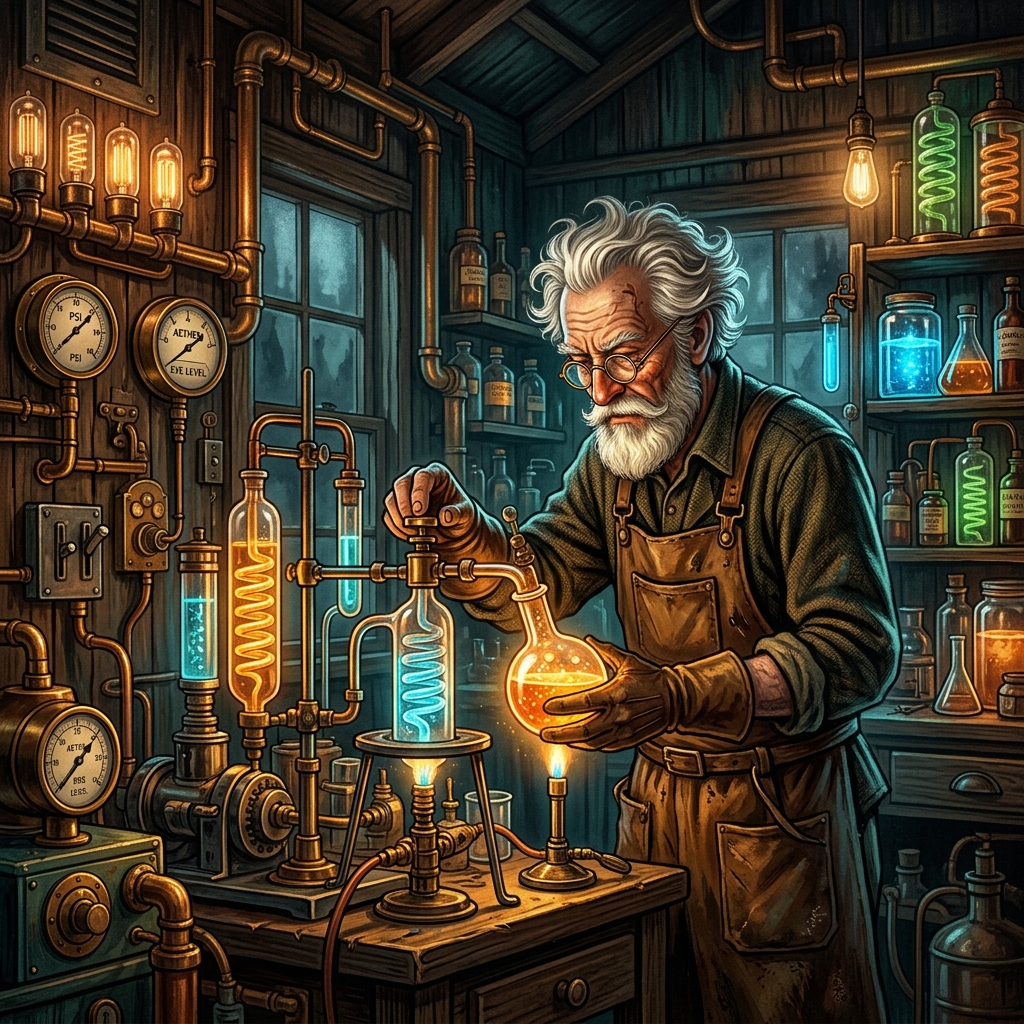
📖 The Origin Archives: Chapter II The Protagonist: Alexander "Sasha" Shulgin—a towering, bohemian biochemist with a passion for classical viola, corduroy jackets, and molecular tinkering. The Laboratory: A weathered timber garden shed on a California smallholding, home to bubbling glassware, spiderwebs, and vintage Beethoven records. The Discovery: The re-synthesis and experiential discovery of MDMA, opening an entirely novel class of psychiatric therapeutics: the *entactogens*.
1. The World’s Most Generous Insecticide
In the grand mythology of modern psychopharmacology, revolutionary breakthroughs rarely emerge from corporate boardrooms or gleaming pharmaceutical skyscrapers. If Albert Hofmann’s discovery of LSD was born from an accidental fingertip absorption during a Swiss bicycle ride, the resurrection of MDMA owes its existence to an American gardener’s war on common pests.
In the late 1950s, a brilliant young biochemist named Alexander "Sasha" Shulgin was employed by the multinational manufacturing titan Dow Chemical. Tall, wildly curly-haired, and gifted with an almost musical intuition for molecular symmetry, Shulgin achieved a genuine commercial triumph: he synthesised Zectran, one of the world’s first biodegradable and extraordinarily profitable insecticides.
Dow was so delighted by the commercial windfall that they handed Shulgin the corporate equivalent of an unrestricted golden ticket: total intellectual freedom and open funding to pursue whatever research took his fancy in their laboratories. Yet whilst his employers imagined novel industrial patents, Sasha’s fascination had long since drifted past agricultural chemistry towards the deepest enigma in the known universe—the human mind.
2. The Garden Shed Laboratory
When corporate executives inevitably grew skittish over Shulgin’s increasingly unorthodox interest in psychoactive mescaline derivatives, they parted company on thoroughly amicable terms. Shulgin retired to his modest family smallholding in Lafayette, California, strolled past the citrus trees into a ramshackle timber garden shed, and set to work.
To describe Shulgin’s private laboratory as "eccentric" would be a colossal understatement. Nestled beneath sprawling oak trees, the shed was a delightfully chaotic sanctuary of bespoke glass reflux condensers, rotary evaporators, antique brass scales, and jars of obscure organic reagents, accompanied by the booming strains of Mozart and Brahms. Armed with an official Schedule I analytical research licence proudly pinned to the wall, Sasha became the solitary cartographer of uncharted neurochemical territory.
3. Resurrecting a Forgotten Ghost (1912 to 1976)
Contrary to popular myth, Shulgin did not invent the molecule 3,4-methylenedioxymethamphetamine. That distinction belonged to the German pharmaceutical firm E. Merck of Darmstadt, where chemist Dr. Anton Köllisch first synthesised it in 1912. Merck had been attempting to synthesise hydrastinine—a haemostatic medication designed to control bleeding—whilst sidestepping a rival patent held by Bayer. Finding no immediate clinical utility for MDMA, Merck patented the intermediate in 1914 and promptly forgot about it for over six decades.
In September 1976, prompted by an intriguing remark from a medicinal chemistry student in San Francisco, Shulgin decided to synthesise a fresh batch of the long-dormant compound in his garden shed. Adhering to his meticulous self-experimentation protocol, he commenced with a minuscule threshold dose of just 16 milligrams. Nothing happened. He stepped it up systematically over subsequent weeks: 25 mg, 50 mg, 80 mg.
Then, on a quiet afternoon at 120 milligrams, the molecular key turned smoothly in the lock. Shulgin noted in his laboratory journal:
"I feel absolutely clean inside, and there is nothing but pure euphoria. But not euphoria in the manic sense—rather an immense inner peace, warmth, and an effortless lucidity. Fear simply vanishes without impairing the intellect."
4. The Molecule That Quieten the Amygdala
Shulgin swiftly grasped that MDMA did not fit into any existing pharmacological category. It was certainly not a classical psychedelic such as LSD or psilocybin—there were no swirling visual hallucinations or dissolution of the ego. Nor was it a crude central nervous system stimulant. It possessed a unique, bespoke capacity to dissolve interpersonal defensiveness, quieten the fear centres of the amygdala, and evoke profound empathy.
To categorise this distinct state, psychopharmacologists subsequently coined the term "entactogen"—derived from Greek and Latin roots meaning "to touch within."
Recognising that this compound held transformative potential for psychotherapy, Sasha introduced it to an esteemed psychologist colleague in Oakland named Leo Zeff. Zeff, who was on the very brink of retirement, was so astonished by MDMA’s ability to unlock decades of deeply buried emotional trauma in single therapeutic sessions that he abandoned retirement entirely. Affectionately dubbed "The Secret Chief," Zeff travelled extensively with a small leather briefcase, introducing MDMA-assisted psychotherapy to an estimated 4,000 clinicians across North America and Europe throughout the late 1970s and early 1980s.
5. The Shulgin Scale & The PIHKAL Chronicles
Together with his wife and co-researcher Ann Shulgin—a gifted lay therapist who pioneered the application of entactogens for grief resolution and Jungian shadow integration—Sasha synthesised and rigorously bioassayed over 230 novel phenethylamines and tryptamines (including 2C-B, 2C-E, and DOM), chronicled in their classic volumes PIHKAL (Phenethylamines I Have Known and Loved) and TIHKAL.
Together, they formalised the famous Shulgin Rating Scale:
Plus One (+) : A subtle, perceptible threshold alteration. Plus Two (++) : A distinctly marked state; normal conversation and daily functions remain easily manageable. Plus Three (+++) : Full immersion in the compound’s character; substantial psychological engagement. The Elusive Plus Four (++++) : A rare, serendipitous state of profound transcendental unity that cannot be recreated merely by increasing the dosage.
6. From the Shed to the Modern Clinic
Today, as contemporary Phase 3 multi-centre clinical trials published in Nature Medicine demonstrate that MDMA-assisted psychotherapy enables over 71% of severe, treatment-resistant PTSD patients to achieve full remission, the medical world is confirming what the eccentric chemist in the Lafayette garden shed observed half a century ago.
Sasha Shulgin passed away peacefully in 2014 at the age of 88, having lived one of the most adventurous intellectual lives in the history of science. He was never motivated by commercial patents or financial monopolies; he believed with wholehearted conviction that the human brain was a magnificent frontier worthy of compassionate, rational exploration.
The Origin Archives: Curated by the OpenMind Initiative to document the extraordinary history, serendipitous breakthroughs, and pioneering scientists of psychopharmacology. Published exclusively for educational, historical, and harm-reduction purposes.


Comments